This article was originally published at blackvoicenews.com.
While the loss of federal funding and elimination of federally-funded subgrants continue to plague nonprofits across the state, local nonprofit organizations in the Inland Empire are holding on strong as local and state foundations work to fill in funding gaps.
A Mapping Black California (MBC) analysis of the flow of philanthropic funding in the Inland Empire demonstrates that such funding in the region takes distinctive paths in terms of what sectors receive the most funding, and therefore which nonprofits see the most financial support and stability.
Notably, older and more established organizations are likely to hold most of the endowment, however, they are still operating on small amounts, according to the data. In contrast, newer organizations account for a majority of the local nonprofit sector, but have little-to-no financial safety nets.
Across the Inland Empire, the healthcare sector receives the most funding, pulling in nearly $50 million annually, according to the MBC analysis. A majority of those funds is cycled through the same networks such as healthcare systems like Loma Linda that fund their own affiliated entities, clinical operations and care networks.
“So, while the dollar amounts look impressive, much of that money isn’t moving into the broader community. It’s circulating within a relatively closed ecosystem,” MBC Project Manager Alex Reed stated.
Education is the second largest sector in the region that receives the most funding, around $38.5 million.
Organizations featured in the “BlackLash” series such as the Sankofa Birthworkers Collective of the Inland Empire, the Time for Change Foundation and Youth Mentoring Action Network (YMAN) all emphasized that federal funding and federal subgrants do not make up a large percentage of their funding. This lack of reliance on federal funding is a result of local and statewide philanthropic foundations.
Though Youth Mentoring Action Network was previously a recipient of a federal subgrant and a recipient of the M.E.C.C.A. IE Fund housed at the Inland Empire Community Foundation, their funding strategy reveals that they have consistent multi-year supporters and build strong relationships with a small group of donors. One of their largest funders is the Weingart Foundation, who contributed over $1.3 million across multiple grants between 2022 and 2024.
“There is a chronic under investment in the IE, definitely from organized philanthropy, in private institutional foundations like ours. So, we address that disparity,” said Weingart Foundation President and CEO Joanna Jackson. “If folks are going to be able to respond [and] build the kind of community infrastructure with sustainability, to be able to do that work, and do that work with a level of resource, then we simply have to invest. If you want this region to thrive for everyone, then everyone needs to be thriving.”
Organizations like the Time for Change Foundation have utilized a wider, more diverse funding network. They have garnered financial support from national corporate foundations, major California-based funders like the California Wellness Foundation, and individual donors who contribute large sums. The Time for Change Foundation was also a recipient of the M.E.C.C.A. IE Fund. According to Reed’s analysis, the organization’s range of grant purposes (housing, workforce development, civic engagement, domestic violence prevention) reflect Time for Change’s “key positioning” across issues that appeal to funders.
Philanthropic foundations in the Inland Empire make the most grants by volume, with over 1,200 grants from 144 foundations. Their median grant is $10,000, and though that amount does not appear to be a large sum, these grants are small, but targeted investments.
“They’re functioning as the main trickle-down bank of the region, spreading dollars across human services, arts and culture, and education,” Reed noted.
Philanthropic contrast between Riverside and San Bernardino Counties
Within the topic of philanthropic funding, San Bernardino and Riverside Counties have notable contrasts.
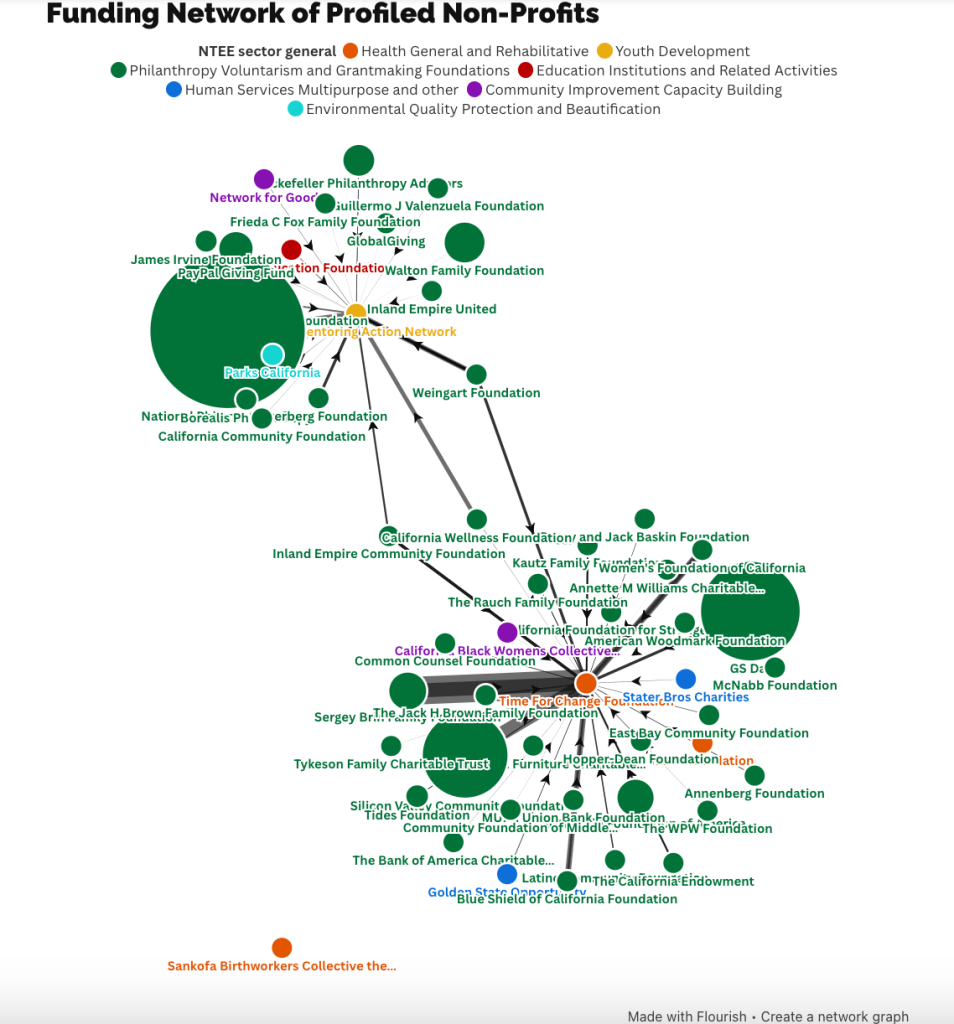
In Riverside County, major foundations like the Inland Empire Community Foundation provide stability for local organizations, allowing them to focus on helping smaller organizations grow, helping mid-sized organizations grow their revenue, and maintaining the overall financial health of the region.
San Bernardino County, though geographically the largest county in the region and financially dominating compared to Riverside County, has fewer organizations. The ones they do have tend to be larger and require upfront investments of large sums.
“A major driver of that is healthcare, specifically the Loma Linda system, which accounts for around 60-70% of total assets in [San Bernardino] county. That level of concentration is something funders need to pay attention to, because if Loma Linda were to experience financial distress, the ripple effects on the broader philanthropic network would be significant,” Reed noted.
Reed’s analysis of the data concluded that San Bernardino needs strategies that are focused on monitoring anchor institutions, strengthening infrastructure, and encouraging diverse mid-tier funding to reduce risks that would hurt the region.
In the Inland Empire, some of the largest issues in the region are identified by poor health and wellness outcomes as a result of systemic barriers and poor social conditions. Human services and community improvement organizations receive a fraction of the overall funds, despite having the largest number of organizations in the network. Though these sectors receive some funding, the amounts are small, and according to Reed, these sectors, in turn, are not being resourced at the level their volume of need would suggest.
A majority of organizations in the region fall into the categories of direct service organizations, arts groups and community development workers. The most common grant amount among these organizations is between $5,000 and $15,000.
“Even 10 of those to one organization just does not make for a sustainable revenue stream when considering the time and energy that has to go into securing these grants,” Reed noted. “The gap between those two tracks is really the defining feature of philanthropy in the Inland Empire right now.”
Across the Inland Empire, federal funding and grants are often distributed to local nonprofits through county partnerships, state programs that match federal funds, and direct subgrants.
Black-led nonprofits face funding crisis amid federal mandates
Black-led and Black-empowered nonprofit organizations, as well as organizations operating or supporting communities of color in the region already face significant challenges as they are often underfunded, understaffed and under-resourced. Recent federal mandates restrict any sort of federal funding for organizations, even contracted by counties, who fall under the category of diversity, equity, inclusion and accessibility. Many are at risk of financial loss.
Though the president’s mandate is directed at federal funds, some private, corporate and community foundations have felt the pressure from the administration as they face threats of eliminating government contracts and scrutiny over their grantmaking.
“If we really believe that we are going to have communities where everyone can thrive, where we actually have equity, where people of color and Black people, in particular, can be seen and have equitable access to all the things that people need to have to be able to flourish and thrive, then we have to invest in those communities and the people that are doing that work,” Jackson explained.
A new report published by data nonprofit organization Candid and the Association of Black Foundation Executives (ABFE), examined trends in funding from foundations for Black-led nonprofits between 2016 and 2023. The report noted that though significant pledges were made from foundations, only a small percentage of Black-led nonprofits received funding, and overall support was short-lived.
“This cycle of short-lived transactional investments keeps organizations doing the crucial work in communities in constant survival mode rather than scaling the solutions our communities need,” Susan Taylor Batten, president and CEO of ABFE, stated in a press release.
The report outlines ways philanthropy can work toward building sustainable partnerships with Black-led organizations such as increasing long-term and flexible funding, and expanding access to philanthropic networks.
“Black-led nonprofit leaders are being asked to meet rising community needs while navigating an increasingly hostile environment toward race-explicit work, often without the flexible, sustained funding needed to build staff, strengthen infrastructure, or plan for the long term,” Batten stated.
In the aftermath of the summer of 2020, which many referred to as a time of “racial reckoning,” Black-led and Black-empowering organizations experienced no retribution or restitution though many pledges and promises were made.
Rather, these nonprofits braced themselves for changes they anticipated with the publication of Project 2025 (initially published in 2023), the re-election of President Donald Trump, and severe cuts to funding that would have a trickle down effect. This anticipation led to the launch of more sustainable investment efforts such as the Black Freedom Fund, and IECF’s M.E.C.C.A. IE Fund which continues to award grants to Black-led and Black-empowering nonprofits across the Inland Empire.
“The Inland Empire is a region that has historically been under-resourced and overlooked. We take seriously our responsibility to change that — and partnerships like the one we have with M.E.C.C.A. and the organizations they fund are exactly how we do it,” stated IECF Chief Impact Officer Celia Cudiamat.
This article, part of a series BlackLash 2025, was reported through a fellowship supported by the Lilly Endowment and administered by the Chronicle of Philanthropy to expand coverage of philanthropy and nonprofits. Black Voice News is solely responsible for all content.

 Breanna Reeves