This is a self-published feature, originally developed for an investigative reporting course.
Meet Bryce
Bryce De La Cruz remembers the night like it happened yesterday.
“He put his hands between my thighs and he leaned in and said to me, ‘I would fuck you if you were a real girl.’”
Bryce, who identifies as a transgender woman, pushed the stranger away as tears streamed down her face.
She was shocked that a man had just assaulted her, but at the same time, she didn’t want tell anyone about it.
“I am so uncomfortable and scared to even see his face again that I didn’t want to,” said Bryce. “I still don’t want to have to see him or speak to him or give him any attention.”
Bryce didn’t believe that reporting her assault would have resulted in any action by the police, fearing that her situation would not be taken seriously because it happened at a college party.
“I think trans girls, specifically, are just underprotected,” Bryce explained. “I don’t think he would have been arrested, or I don’t think anything bad would have happened to him, besides like filing a report to a police department.”
Bryce isn’t alone. She is among thousands of LGBTQ+ community members who fail to report hate crimes because such reports are not taken seriously, they get swept under the rug, and these crimes rarely go to trial. According to the 2015 FBI Hate Crime Statistics Report, there were seventy-five anti-transgender hate crimes (crimes like assault or homicide committed against someone because of their gender) that occurred because of bias toward members of the LGBTQ+ community. And those were just the hate crimes that were reported.
The problem
“I think [hate crimes] are underreported, tremendously,” explained Theresa Sparks. Sparks was the first transgender woman to serve as the president of the San Francisco Police Commission and currently serves as Mayor Ed Lee’s senior adviser on transgender initiatives.
According to the San Francisco Lesbian, Gay, Bisexual, Transgender, Queer & Intersex Violence Prevention Needs Assessment, developed by the SF LGBT Center and Learning for Action, an overall 36 percent of LGBTQI community members don’t believe the police would help them.
“Transgender community members, people of color, and those with lower incomes or who have experienced homelessness are least likely to believe that police will come to their aid,” said the report.
Sparks, along with the Human Rights Commission, helped contribute to the report, and found the findings shocking.
“What we found out was a number of things,” Sparks said. “One, there’s more crime in the Castro than anybody thought.” Sparks emphasized that the report revealed that many members of the LGBTQ+ community felt more comfortable reporting to their friends and family than the police.
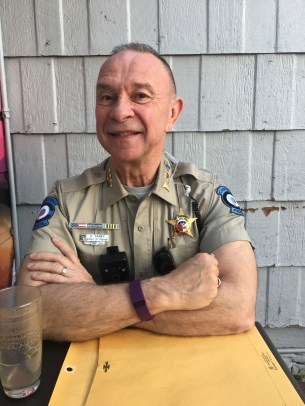
As a 20-year resident of San Francisco and the Castro, and a witness to several LGBTQ+-related hate crimes, Greg Carey, Chief of Patrol for the Castro Community on Patrol (CCOP), noted that, “the communication across these different groups is very poor.”
“[SFPD] is very small in number. They try to do the best they can with the resources they have,” said Carey. “San Francisco’s police force is down about 300 to 400 officers from the ideal number. So, we are very understaffed in the police department here in San Francisco.”
Carey attributed that the mistrust between the LGBTQ+ community and the police is a result of the assassination of George Moscone and Harvey Milk.
“So, forty years ago…the police and the LGBTQ community were completely enemies,” Carey explained. “Forty years have passed, and that has changed immensely, but people still remember these things that happened forever ago.”
The poor relationship between the LGBTQ+ community and SFPD today remains to cause a divide between community members and officers, and has resulted in community members not reporting hate crimes.
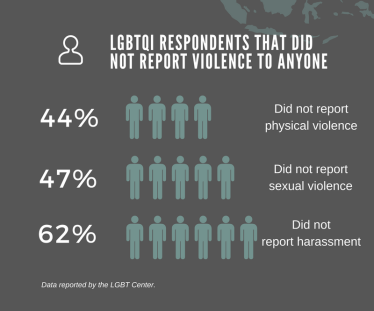 After a local assessment of San Francisco communities was conducted, the LGBT Center report said that “a substantial proportion of LGBTQI respondents did not report the violence they experienced to anyone,” (left).
“After the election, there was a lot of concern about hate crimes,” Carey said. “Luckily, we have not seen any hate crimes as a result of the election. San Francisco, so far, has been pretty immune to that, but we don’t know that it’s going to stay that way, so we kind of prepare for the worst and hope for the best.”
While the 2016 Presidential Election may not have had as big an impact on hate crimes in the Bay Area compared to other states, hate crimes in San Francisco have steadily increased over the past three years.
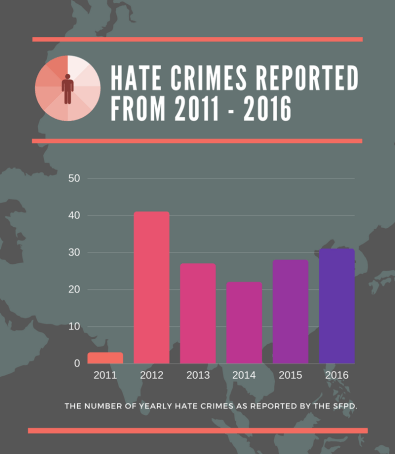
Sgt. Michael Andraychak said that the department documents yearly hate crimes reported, as pictured to the right. But what is not pictured are the suspected number of hate crimes that were not reported.
The San Francisco District Attorney’s office explained that their “office is more limited to the cases we charge.”
The DA’s office charges hate crimes using guidelines laid out in Penal Code sections 422.75 and 422.7. These sections explain that the punishment for felony charges can be lengthened by one, two, or three years if a “hate crime” is added and explains the characteristics that make up a hate crime.
Assistant District Attorney Benjamin Mains, who has been prosecuting hate crimes since May 2016, explained that hate crimes are a complex crime, especially for San Francisco because the District Attorney’s office doesn’t typically charge hate crimes without an accompanied crime like assault.
Mains “absolutely thinks [hate crimes] are underreported,” however, different perceptions of what a hate crime is affects why they are underreported.
But not everyone agrees that hate crimes are underreported.
“I don’t think [hate crimes] are underreported,” Carey insisted. “I think they’re overreported because most people believe just the language itself is already the crime and they are already going to be up in arms about that.”
Carey is one of many who believe that the language surrounding hate crimes leads to confusion, however, those who are unsure about being victims of hate crimes are discouraged from reporting crimes due to reactions such as this.
The truth
“We were hearing a lot of stories from the community about hate crimes,” Sparks said. “We also heard, anecdotally, comments about how the LGBT community doesn’t trust the police department.” These anecdotes is what led to the LGBT community report.
Incidents among police officers have showed that bias plays a role in generating fear among communities and those who interact with officers.
Bryce’s lack of trust in the SFPD’s capability to follow up on cases is not unfounded. She has heard several instances of no action from the SFPD, and fears that because she is a transgender woman, the SFPD will write her off.
“I’ve heard some sexual assault stories where police have never followed up, especially with trans girls, too. It’s just put in a file and never talked about again,” Bryce insisted. “I don’t think people understand how much hatred is around my group of people, my community, specifically.”
An assessment report conducted by the U.S. Department of Justice on the San Francisco Police Department revealed that, “While data alone do not prove bias, issues of explicit and implicit bias continue to challenge the SFPD.”
Sparks recognizes that the relationship between the LGBT community and the police “hasn’t been the best relationship” and argues that the mistrust between the two stemmed from indications of homophobia and transphobia in the police department.
The report also explained that San Francisco does not adequately track policing efforts and therefore are not always aware of what interactions officers have with community members.
Tracking hate crimes has proven to be difficult because law enforcement officials must prove that the intent behind a crime was motivated by bias, according to Lecia Brooks, a spokesperson for the Southern Poverty Law Center.
The SPLC tracks hate groups throughout the U.S. and encourages people to report hate crimes. Brooks explained that the SPLC does not directly interact with victims of hate crimes, but they create data reports that can help local communities and law enforcement agencies track hate crimes.
There are currently a total of seven active anti-LGBT hate groups in California. Four of them have headquarters in the Bay Area: Chalcedon Foundation, Pacific Justice Institute, Save California, and Verity Baptist Church.
What can be done?
“What I always recommend is report it twice. Report it once to the police department, absolutely,” Sparks encouraged. “Fill out the forms, file a report. And then go to a community-based organization like CUAV and file it there. And what CUAV will do is they track it.”
Community United Against Violence (CUAV) is an organization that supports the LGBTQ+ community and those who have faced violence and oppression.
The LGBT Center report said “providers and community members expressed doubts as to whether or not violence against LGBTQI communities can effectively be solved through traditional avenues offered by law enforcement and the criminal legal system.”
“I think it’s important for (SFPD) to know that we are more at risk for harm than a lot of other groups in the community just because we are probably the biggest minority,” Bryce implored.
Despite believing that hate crimes are overreported, Carey did emphasize the importance of reporting a crime, even if there is no chance of catching the culprit. Carey argued that it’s important for the public to go through the process of working with the district attorney, if necessary.
“This is true of all crime: if a crime isn’t reported, it never happened,” Carey added. “Even if it was a serious crime, if it wasn’t reported and if the victim wasn’t willing to be apart of the process, that crime never occurred.”
Sparks acknowledged that transgender youth are most at risk. She explained that sometimes the Human Rights Commission will mediate hate crime reports and send a facilitator to be present to sit between the police officer and the victim to make sure the interview is done fairly.
Finding solutions
After the SFPD was investigated by the Justice Department as requested by Mayor Ed Lee in 2016, the SFPD has sworn to make changes to its training practices and to implement more bias training among officers.
The U.S. Department of Justice (DOJ) Office of Community Oriented Policing Services (COPS Office) made numerous recommendations regarding the conduct of the SFPD, including re-introducing representative forums that meet with the chief of police to discuss issues plaguing certain communities.
As of now, police recruits receive a “two-hour block of instruction on Hate Crimes” that is taught by Sgt. Pete Shields of the Special Investigation Department, according to Sgt. Andraychak. The learning objectives include being able to “classify the [hate] crime and the elements to arrest for,” “describe the impact of hate crimes on victims, the victims’ families, and the community,” and “discuss the indicators of hate crimes.”
Hate crimes do not always get reported as such and do not always make it to trial. Part of defining hate crimes begins with spreading the word about what is and what isn’t a hate crime and how communities define them.
“There may also be instances when an SID inspector files a case with the DA’s Office alleging a hate crime but the DA’s Office, upon review of the case file, does not believe that the evidence supports such a charge,” said Sgt. Andraychak in an email. “The burden of proof for arrest is probable cause, the DA’s burden of proof in court to file charges and secure a conviction is beyond a reasonable doubt.”
Aside from the two-hour block of instruction on hate crimes, the SFPD does not require annual training on hate crimes. Hate crime investigations that are not dismissed are essentially handled by the Special Investigations Unit (SID) who work in the Hate Crime Unit.
SID Hate Crime Inspectors declined to be interviewed.
Part of why victims do not report hate crimes is because they are rarely brought to trial because they are hard to prove.
The DA’s office filed a total of ten cases in 2016, and of those, four hate crime cases went to trial.
As of February 23, 2017, there are currently fifteen active hate crime cases that have been filed and are currently being prosecuted: five are misdemeanors and ten are felonies.
Bryce believes that education is a key factor when law enforcement agencies are dealing with hate crimes, especially hate crimes against minority communities.
While San Francisco is assumed to be a safe space for the LGBTQ+ community, hate crimes do occur.
“Luckily, for me, living in San Francisco, I don’t get as much negative attention as I know many other trans girls do, but it definitely happens to me,” said Bryce.
Bryce is one of possibly hundreds of survivors who have experienced hate crimes and did not report it because of lack of trust in the system, wariness of the SFPD, and because she felt she wasn’t supported. Reporting hate crimes should not be restricted and communities should feel open about reporting such crimes.
“Being sexually harassed, it’s never warranted and it’s not okay,” said Bryce.


 Breanna Reeves